
Neom: A Green Modern City Plan in the Arabian Desert
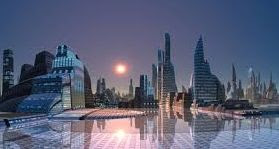
According to Saudi Arabia's state news agency SPA, Crown Prince Mohammed bin Salman announced on Monday that he wants to house 9 million citizens in his new city plan.
Its unique design features two skyscrapers facing each other that are 500 meters tall, taller than the Empire State Building. Their width is said to be more than 100 km. They are part of the Saudi prince's $500 billion Neom project, which promises to transform a desert the size of Belgium into a modern city.
Mohammed bin Salman announced the mega project in 2017 and pledged that the project would lay the foundation for a more modern urban life. This is expected to increase foreign investment to reduce the economy's dependence on oil exports.
But despite the passage of five years, the Neom project is facing delays, with the biggest difficulty being the realization of the Saudi prince's dreams.
His Royal Highness: #NEOM is one of the most important projects of Vision 2030, and we are committed to presenting #THE_LINE to the world.#SPAGOV
— SPAENG (@Spa_Eng) July 25, 2022
A dream of a green and modern city in the desertHis Royal Highness announces designs for #THE_LINE, the city of the future in #NEOM.#SPAGOV pic.twitter.com/LDyQrMd0lF
— SPAENG (@Spa_Eng) July 25, 2022
Glow-in-the-dark beaches, billions of trees in a country of vast deserts, passenger trains running above the ground by magnetic force, a simulated moon, a 100-mile eco-friendly city along the desert.
These are some of the plans for a proposed future residential city called 'Neum'. Saudi Arabia wants to build such a city as part of its commitment to make its country green.
Is all this really possible?
Neom management claims that this is a map of the future, according to which humanity will set the goals of development and modernization, but will not have any negative impact on the environment of the planet this development.
The urbanization project is worth around $500 billion and is part of Saudi Arabia's ambitious Vision 2030 plan to wean its economy off oil. It should be noted that the oil industry has made Saudi Arabia a rich country, but now Saudi Arabia wants the country's economy to be less dependent on oil.
The city will be built on a total area of 26,500 square kilometers (10,230 sq mi), an area larger than Kuwait or Israel combined. The city's planners claim that Saudi laws will not apply in the city because it will be an autonomous region with a system designed to attract investment.
Former banker Ali Shahabi is included in the advisory board of Neom. They say the massive region will include the construction of a 170-kilometer (105-mile) long city, called 'The Line', which will be settled as a straight line in the desert.
The plan for this city seems far-fetched, but Shahabi says that it will be built in a phased manner.
''it's a crazy project that's going to cost hundreds of billions of dollars, but it's going to happen in a phased manner, exactly where there's not much of a gap between supply and demand.'' people said.
It will be like Barcelona's traffic-free 'superblocks', where each block will be self-sufficient and have amenities like shops and schools so that people can find anything they need five minutes away, he explains. Available within walking or cycling distance.
Planners claim that when the city is complete, it will be accessible by high-speed trains. And it will take at most 20 minutes to reach from one corner of the city to another.
Also interesting would be the trade or commercial center of Neom which itself would be a small floating city on the water. According to the plan, the commercial center of the city will cover an area of seven kilometers (4.3 mi) and will be the largest floating architectural structure in the world. Nazmi Al Nasr, chief executive of Neom, says the port city will "welcome its first tenants in early 2022."
The project's website sometimes looks like a science fiction novel.
Currently, the vision for the new city is that, but the reality is less so.
A recent satellite image shows that a square has been built into the proposed 'The Line'. Along with row houses, it also has two swimming pools and a football ground.
But how is it possible to build such a modern city in the middle of the desert that is also green?
Dr Manal Shahabi, an energy expert at the University of Oxford, says there are many things to consider when assessing the feasibility or sustainability of the Neom project. For example, will the food that the residents eat here be produced at a local level that does not use too much resources or will the city depend on food imports from abroad?'
While the website claims that Neum will be the 'most self-sufficient city in the world in terms of food'. It has a concept of vertical farming and greenhouses that would be revolutionary for a country that currently imports about 80 percent of its food from foreign countries. Questions are rightly raised as to whether this will be permanently viable.
It should be noted that the city of Neom is the dream of Saudi Crown Prince Mohammed bin Salman. And critics charge that they are making big claims and promises about the environment and presenting a green garden to divert global attention from Saudi Arabia's realities on the ground.
The city is part of the Crown Prince's concept of a 'Green Saudi Arabia'. A week before the COP 26 climate change talks, he also launched the Saudi Green Initiative, which has announced a goal of achieving zero carbon emissions by 2060.
Dr Joanna Depledge, an expert on international climate change negotiations at the University of Cambridge, said it was initially seen as a big step but it did not meet the criteria after scrutiny. She points out that to reduce warming in Saudi Arabia to 5.1 degrees Celsius, global oil production needs to decrease by about five percent annually between now and 2030.
But despite this, Saudi Arabia has hinted at increasing oil production just weeks after making headline-grabbing 'green promises' at this year's COP-26 climate conference. Saudi Arabia's energy minister, Prince Abdulaziz bin Salman, reportedly said the Saudis would not stop producing oil. "Saudi Arabia will be the last country to do this until every molecule of hydrocarbons is extracted."
Dr Depledge says: 'I think it's quite shocking that Saudi Arabia still thinks it can continue to exploit and extract oil in the current context.'
A country's carbon emissions come from the fuel it burns, rather than the fuel it pulls out of the ground. So if a country like Saudi Arabia produces millions of barrels of oil a year, and sends it to other countries, that country doesn't need to count.